Thomson Reuters
 

 ScienceWatch

FAST MOVING FRONTS - 2010

May 2010 Download this article
 
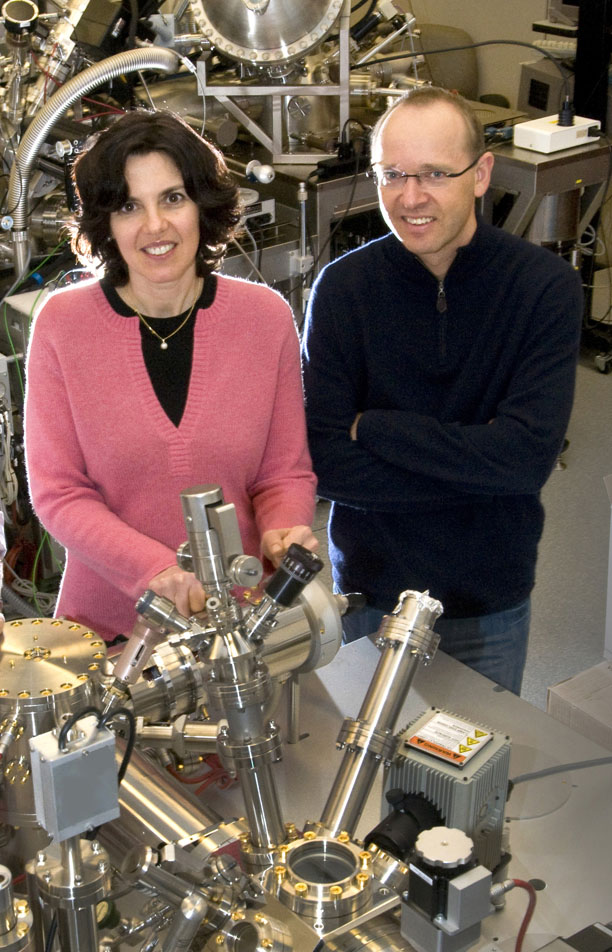
Eli Sutter & Peter W. Sutter talk with ScienceWatch.com and answer a few questions about this month's Fast Moving Fronts paper in the Multidisciplinary field. The authors have also sent along images of their work.
Eli Sutter & Peter W. Sutter

Enlarge

Article: Epitaxial graphene on ruthenium
Authors: Sutter, PW;Flege, JI;Sutter, EA
Journal: NAT MATER, 7 (5): 406-411 MAY 2008
Addresses: Brookhaven Natl Lab, Ctr Funct Nanomat, Upton, NY 11973 USA.
Brookhaven Natl Lab, Ctr Funct Nanomat, Upton, NY 11973 USA.

  Why do you think your paper is highly cited?

At the time our paper was published, graphene had shown extraordinary properties, such as high charge-carrier mobilities, chemical inertness, and extreme mechanical strength. But a scalable method for large-scale synthesis, necessary to pursue further research and possibly translate some of these properties into technological applications, had been lacking.

The leading contender at the time, epitaxial graphene on silicon carbide, had produced material with good electronic properties, but was also plagued by problems: small size of graphene domains; poor thickness uniformity; and the inability to isolate the graphene from the substrate.

At this critical time, our paper demonstrated that transition metal substrates can be used to grow high-quality epitaxial graphene with macroscopic domain sizes and excellent thickness uniformity. Later work by other groups has demonstrated ways to isolate the graphene from the metal, making it available for a wide range of applications.

  Does it describe a new discovery, methodology, or synthesis of knowledge? Would you summarize the significance of your paper in layman’s terms?

Figure 1 Enlarge
Click for larger image
Epitaxy transition metals - scalable graphene synthesis for large-scale applications.
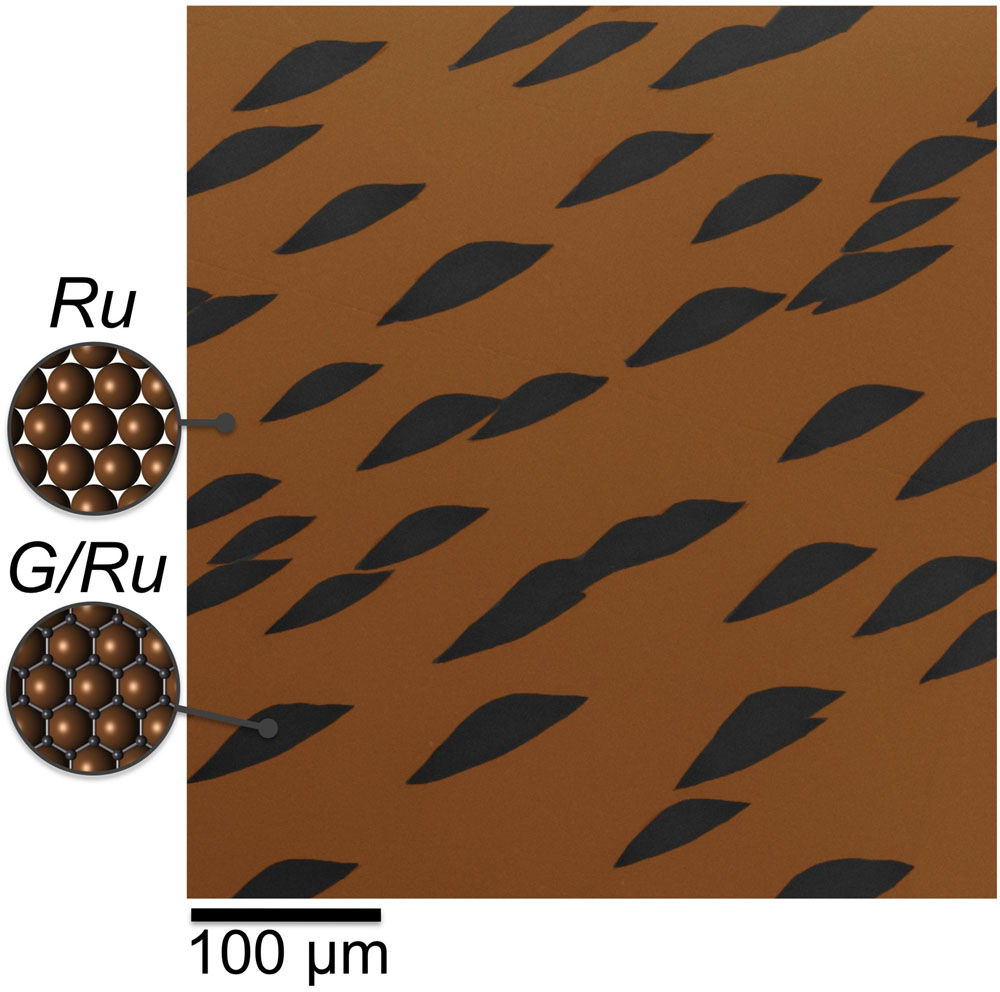
Figure 2
Click for larger image
SEM image at the early stages of graphene growth on ruthenium—partial surface coverage by macroscopic graphene domains.

The fact that transition metals catalyze the growth of graphitic carbon layers has been known since at least the late 1970s, primarily because such layers suppress chemical reactions on these metals.

The discovery of graphene's interesting properties has provided an entirely new context for such work. Using real-time microscopy during the growth process, our work was first to demonstrate the extraordinary control in graphene epitaxy offered by metal substrates, such as ruthenium.

Graphene domains—the two-dimensional equivalent of grains in a polycrystalline material—grow to macroscopic size (several hundred microns), are uniform in thickness, and join together to cover arbitrarily large surface areas. These characteristics ideally fulfilled the requirements for a scalable graphene synthesis method.

The large domain size implies extremely long diffusion lengths of carbon atoms on the metal, but also a special way in which a coherent graphene sheet accommodates atomic layer high surface steps that are ubiquitous on metal surfaces and typically spaced less than 100 nm apart. The graphene flows seamlessly across these steps, akin to a carpet rolled down a flight of stairs.

  How did you become involved in this research and were any particular problems encountered along the way?

Our group has been working on fundamental mechanisms of epitaxial growth and nanostructure formation for a long time, and has a long track record of using in situ microscopy to study growth processes.

Having used transition metal substrates, such as ruthenium and platinum, for other research, it was a small step to applying our knowledge and experience towards understanding the growth and properties of epitaxial graphene.

  Where do you see your research leading in the future?

We have successfully demonstrated the large-scale synthesis of high-quality graphene on metals, thus paving the way for the production of material for the "top-down" fabrication of useful structures. The next challenge in the field is the development of a methodology for the atomically precise "bottom-up" synthesis of graphene nanostructures.

A wealth of theoretical work has predicted unusual, but potentially very useful functionalities arising when charge carriers are confined inside narrow graphene ribbons or other structures with reduced dimensionality.

To harness these properties, however, a ribbon would need to be uniformly narrow, merely a few of graphene's characteristic honeycomb units wide, with atomically straight and smooth edges. We believe that graphene assembly on transition metals can be a key player in realizing this vision.

  Do you foresee any social or political implications for your research?

We have already seen a sharp rise in the research funding for work on graphene, and specifically to address the need for scalable synthesis methods. The promise stands that the extreme properties and relative robustness of graphene, combined with the fact that carbon is among the most abundant elements on our planet, will enable broad applications in areas such as energy efficiency and renewable energy conversion.

Peter Sutter
Staff Scientist
Center for Functional Nanomaterials
Brookhaven National Laboratory
Upton, NY, USA

Eli Sutter
Staff Scientist
Center for Functional Nanomaterials
Brookhaven National Laboratory
Upton, NY, USA

KEYWORDS: CARBON NANOTUBES; GRAPHITE; LEED; GAS.

Download this article


2010 : May 2010 - Fast Moving Fronts : Eli Sutter & Peter W. Sutter Discuss Epitaxial Graphene on Ruthenium
Science Home  |  About Thomson Reuters  |  Site Search
Copyright  |  Terms of Use  |  Privacy Policy
Previous
left arrow key
Next
right arrow key
Close Move