Durham University's Citation Achievements in Space Science
Institutional Feature, March 2011

 The early history of the
expanding universe and the growth of its large-scale structure are
topics of immense importance in modern cosmology. In the past
decade cosmologists have reached a consensus on the values of the
fundamental parameters that define the nature of our universe. But
cosmology is more than a quest for numbers. The earliest moments
of the Big Bang defined the subsequent evolution of the universe
and the way in which structure formed.
The early history of the
expanding universe and the growth of its large-scale structure are
topics of immense importance in modern cosmology. In the past
decade cosmologists have reached a consensus on the values of the
fundamental parameters that define the nature of our universe. But
cosmology is more than a quest for numbers. The earliest moments
of the Big Bang defined the subsequent evolution of the universe
and the way in which structure formed.
The early history of the expanding universe and the growth of its large-scale structure are topics of immense importance in modern cosmology. In the past decade cosmologists have reached a consensus on the values of the fundamental parameters that define the nature of our universe. But cosmology is more than a quest for numbers. The earliest moments of the Big Bang defined the subsequent evolution of the universe and the way in which structure formed.
In Essential Science IndicatorsSM from Thomson Reuters, the work of Durham University ranks at #22 among the 140 institutions comprising the top 1% in the field of Space Science. Durham's current record in this field includes 1,278 papers cited a total of 48,057 times between January 1, 2000 and October 31, 2010.
 Carlos, first let me congratulate you on your
two recent awards, the Fred Hoyle medal from the Institute of Physics
and the George Darwin medal from the Royal Astronomical Society, both of
which mark your impressive contributions to cosmology. When you joined
Durham physics in 1985 it was not noted as the center of excellence that
it has become. How is the group organized?
Carlos, first let me congratulate you on your
two recent awards, the Fred Hoyle medal from the Institute of Physics
and the George Darwin medal from the Royal Astronomical Society, both of
which mark your impressive contributions to cosmology. When you joined
Durham physics in 1985 it was not noted as the center of excellence that
it has become. How is the group organized?
Our growth is relatively recent. In the 25 years I have been here the number of astronomers has grown from half a dozen to more than 150. We are one of the largest and most productive astrophysics research groups in the world.
We are organized into three basic components: observational extragalactic astronomy, theoretical astrophysics and cosmology, and instrumentation. The three legs to our program are closely integrated. This is a research school where theorists such as myself have carried out observations using instruments built by the group. Everybody has an interest in what we do, and many have a stake in all three strands.
Theory here is organized around a new Institute for Computational Cosmology (ICC), of which I am the Director. Our new building was largely funded by a generous alumnus, Sir Peter Ogden, who pursued his Ph.D. in theoretical physics at Durham.
Can you give me an example from the highly
cited papers of this close teamwork?
Yes, a rather good example is the 2000 Monthly Notices of the Royal Astronomical Society paper, "Hierarchical galaxy formation" (319[1]: 168-204, 21 November 2000), with Shaun Cole as first author, which ranks at #6 among our Highly Cited Space Science papers in your database. That paper, written by four theorists from ICC, arose from an earlier paper (1994) by observers and theorists. The two papers epitomize what Durham is all about: a golden era of team work, integrating all aspects of the subject, plus, a focus on questions that are very well defined.
Durham is a relative newcomer to big hits in
extragalactic astronomy. There's no history here in the sense of
tradition, quite unlike Cambridge for example. So what's the secret? How
did Durham get into the cosmology game?
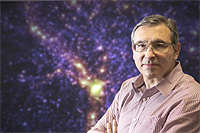
Professor Carlos S. Frenk.

Professor Ray Sharples.
Photo credit Durham University.
It did not happen by chance. When Richard Ellis, who went from Durham to Cambridge and is now at Caltech, and I got this group going 25 years ago we discussed how to expand activity. For the two of us the choice was quite clear: we could try to copy Cambridge (where I originated) and attempt to be good at a large number of areas of astrophysics, or we could focus on just one area and go for the kill. My goal was always to be better than Cambridge in what we did. We chose to concentrate solely on extragalactic astronomy: galaxy formation and the large-scale structure of the universe.
We were, of course, very lucky because that turned out to be the area of growth scientifically. One aspect of our expansion is that the three zones of research activity have of necessity become more autonomous; for example, I no longer observe, because I do not have the time. As director I run a flat organization: everyone is judged solely on the quality of their ideas and their research. That's why almost all of the highly cited papers have several authors; there is no prima donna at Durham.
Carlos, about a third of Durham's highly
cited papers from 2000-2010 arise from the amazing Two Degree Field
Galaxy Redshift Survey (2dFGRS). I'm aware the survey was conducted
between 1999 and 2002 using the 3.9m Anglo-Australian Telescope (AAT).
It's impressive that the survey targeted 232,155 galaxies and thereby
probed the large-scale structure of a section of the local universe.
Allow me to bring in your colleague Ray Sharples to explain the
instrumental contribution that Durham made to this international
collaboration. So, Ray, what's the story here?
The instrumentation used for the 2dFGRS, or the 2dF, was designed from the ground up for a specific scientific project to carry out a survey of galaxy and quasar redshifts, and with an emphasis on high throughput. The combination of a large field of view and the large aperture of the AAT made for a powerful survey instrument.
We used multiplex spectroscopy techniques developed in the previous 5-10 years which utilized fiber optics to collect data simultaneously on many targets. To speed up the process of arranging the fibers inside the field of view we used automated pick-and-place technology developed at Durham specifically for redshift surveys. For the 2dF we took the technique several steps further with a new gripper for efficient positioning, as well as algorithms so that the positioning robot could handle a greater number of fibers.
Instead of adapting a spectrograph already available at the AAT, a fully integrated system of much higher efficiency was built with far better integration of the component parts: dedicated spectrographs, a dedicated wide field optical collector, and a bespoke top end to the telescope. The instrumentation was Durham's big technical contribution to 2dF and, whilst much of the final instrument hardware was produced at the AAT, it was based on prototypes developed at Durham in the 1980s and 1990s.
Back to you Carlos. What role did the Durham
group play in understanding the data?
We led aspects of the analysis and introduced the powerful, and now widely used, strategy of integrating the analysis of the data with state-of-the-art cosmological simulations. The survey itself involved numerous astronomers in the UK and Australia. Without question 2dF was one of the greatest highlights ever of UK observational astronomy. We competed with the Sloan Digital Sky Survey (SDSS) even though our budgets differed by an order of magnitude. In cosmology and large-scale structure, we managed to get ahead of the game and many of the initial discovery papers came from 2dF.
What are the big achievements of
2dF?
It was a stroke of genius to build an instrument that enabled the measurement of hundreds of redshifts at a time. This led to a very focused campaign to measure redshifts for 250,000 galaxies. By adding the redshifts to the mapping data you get the three-dimensional structure.
Page: < 1 | 2 >